Ethiopia's Tech Ecosystem in 2026: What Global Companies Need to Know Before They Hire
Ethiopia is emerging as one of Africa's fastest-growing technology hubs. Here is a clear-eyed look at the state of Ethiopia's tech ecosystem in 2026—what's real, what's growing, and what it means for global companies looking to hire.

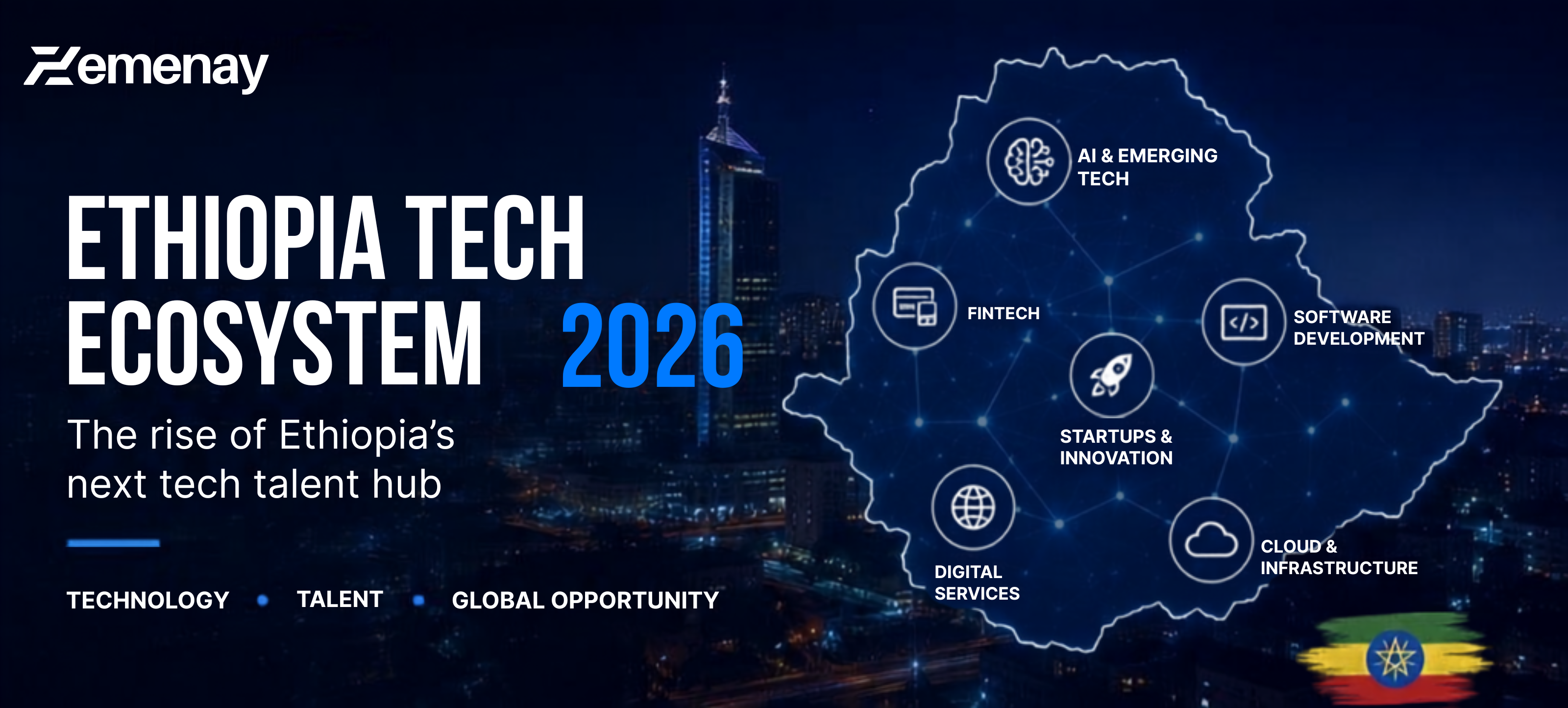
Most articles about the Ethiopian tech ecosystem are either written by people who have never been there—full of vague superlatives and unsourced statistics—or by advocacy organizations whose interest is in painting the rosiest possible picture.
This article is neither. It is written from inside the ecosystem, with the specific goal of giving international companies an accurate picture of what they will find when they look to hire Ethiopian tech talent.
Here is the truth.
The Foundation: Education and Output
The Ethiopian higher education system has expanded dramatically over the past decade. The country now has over 45 public universities, several of which have strong technology programs. Addis Ababa University and the Addis Ababa Institute of Technology (AAiT) are the flagship institutions, producing graduates in software engineering, electrical and computer engineering, information technology, and data science.
The quality of education varies—as it does in any large system. The best graduates from the top institutions are genuinely strong, with solid foundations in algorithms, data structures, systems programming, and mathematics. The graduates from weaker programs have more variable preparation.
The critical filter: most of the developers who matter for international hiring are not fresh graduates. They are engineers with 3–8 years of post-graduation experience who have built on their academic foundation through real commercial work. That segment of the market is where the strongest talent lives.
The Commercial Ecosystem
Addis Ababa hosts an active startup scene. Companies like iCog Labs (AI research and development) and Gebeya (tech talent development) have built serious technical organizations that have produced engineers who have worked on real products with real stakes.
International technology companies have also been hiring Ethiopian developers for years—quietly, and with good results. This has had a compounding effect: engineers who worked at international companies brought back practices, tooling standards, and professional habits that raised the baseline for the whole community.
The fintech sector deserves special mention. Ethiopia's financial technology sector has been growing rapidly, and the developers who have built payment systems, banking applications, and financial data products have developed the kind of pressure-tested engineering experience that translates directly to international teams.
The Honest Limitations
Any accurate picture of Ethiopia's tech ecosystem must include its constraints.
Internet infrastructure is improving but not universal. Addis Ababa has good connectivity. Engineers in the capital generally have access to reliable broadband. Outside major urban centers, this is less consistent. For remote work, internet reliability is a real operational consideration.
The talent pool is concentrated. The vast majority of hireable senior tech talent is in Addis Ababa. This is common for emerging tech ecosystems—talent concentrates in the capital before distributing—but it limits the geographic diversity of sourcing.
Junior talent requires more development. Some Ethiopian developers who apply for international roles are still building their foundational skills. This is not a knock—it is a characteristic of a young, growing ecosystem. The implication for hiring teams is that careful vetting is essential.
Salary expectations are evolving. As more Ethiopian engineers land international placements and discuss compensation openly, market rates are rising. This is good for developers and good for the ecosystem. It means that companies trying to pay far below market will find the best candidates unavailable to them.
The Strengths That Are Genuinely Distinctive
With limitations honestly stated, here is what is genuinely strong about Ethiopian tech talent:
Motivation and investment
Ethiopian developers who land international placements are not doing this as a fallback option. International work is a prestigious, well-compensated opportunity in local terms. This generates a level of commitment and professional investment that translates into lower attrition and better performance.
Mathematical grounding
Ethiopian university education emphasizes mathematical foundations more heavily than many Western programs. This shows up as a genuine strength in algorithm-heavy work, systems design, and domains that require mathematical reasoning—including AI/ML engineering.
English fluency in technical contexts
Higher education in Ethiopia is conducted primarily in English. Technical developers are fluent in the language of documentation, code, and professional collaboration. Communication in international teams is not a significant hurdle for well-educated Ethiopian engineers.
Hunger for craft
The best Ethiopian engineers are not clock-punchers. They are developers who have sought out harder problems, built personal projects, contributed to open source, and pursued continuous self-development because they wanted to—not because a company mandated it. This is not universal, but it is common among the top tier.
The Stack Distribution
Based on our placement experience, here is what the Ethiopian developer community specializes in:
| Technology | Community Depth | Senior Talent Availability |
|---|---|---|
| React / Next.js | High | Good |
| Node.js | High | Good |
| Python (Django, FastAPI) | High | Good |
| Flutter | Medium-High | Growing |
| Java / Spring Boot | Medium | Available |
| .NET / C# | Medium | Available |
| Three.js / WebGL | Low-Medium | Specialist search required |
| AI/ML (PyTorch, TF) | Growing | Selective |
| DevOps / Kubernetes | Medium | Available |
| Go | Low | Specialist search required |
What This Means for Hiring Companies
The Ethiopian tech market rewards patience and proper process. Companies that post a generic job description and expect to be flooded with qualified applicants will be disappointed. The strong developers are usually not actively hunting—they are working, building experience, and waiting for the right opportunity.
Finding them requires:
- Network access within the Ethiopian developer community
- A credible reputation as a genuine employer of talent
- A vetting process rigorous enough to be respected
- Competitive compensation at international norms, not local minimums
The companies that do this well consistently report that Ethiopian developers are among the most committed and capable remote team members they have worked with.
Zemenay's Position in This Ecosystem
We are not a Western company that decided Africa is a good arbitrage opportunity. Zemenay was built inside Ethiopia's tech ecosystem. We know which institutions produce the strongest graduates, which communities contain the best senior engineers, and how to assess quality in a market that requires local knowledge to navigate.
Our placements are built on this foundation: genuine ecosystem knowledge, rigorous vetting, and a commitment to making matches that last.
Ready to Work With an Ethiopian Tech Company?
Zemenay is built from the inside of Ethiopia's tech ecosystem — not looking in from the outside. We recruit, we vet, and we place developers. We also build web and mobile products, handle SEO and deployment, and manage customer support for international clients.
Whatever you need built or staffed, let's talk.
Book your free consultation today.