Where to Get the Best Price for Custom Software Development in 2026
The lowest quote is rarely the best price. See how custom software pricing really works, and why Africa and Ethiopia belong on your shortlist.

Every founder who has asked for a software quote knows the feeling. You send the same brief to three companies and three numbers come back: $40,000, $180,000 and $450,000. The gap is so wide that it is hard to believe they read the same document.
So where do you actually go to get the best price for custom software?
The honest answer has two parts. First, "best price" does not mean "lowest quote". It means the lowest total cost of software that ships, works and keeps working. Second, geography is still the biggest pricing lever that most buyers never pull. The same engineering hour can cost three times more in one city than in another, and the gap has very little to do with how good the engineer is.
In this guide we walk through the numbers: the global picture first, then Africa, then Ethiopia, and finally ZemenayTech, the company writing this. We are based in Addis Ababa and we obviously have an interest in the answer, so every statistic below links to its source, and we point out where the data is thin or the headlines overreach.
The short version
- Large IT projects run 45% over budget on average and deliver 56% less value than promised, so the cheapest quote is not automatically the cheapest project.
- Outsourced development rates run roughly $80-$180+ an hour in North America and Western Europe, versus roughly $25-$65 in Africa.
- Africa's developer community grew 21% a year between 2019 and 2024, faster than any other continent.
- Ethiopia is among the fastest-growing developer markets on the continent, with a very young population, a national coding push and a low cost base.
- The best price comes from a fair hourly rate, a clear scope and low rework. All three, not just the first.
What "best price" actually means
Most quote comparisons stop at the hourly rate or the project total. That is a bit like choosing a car by the sticker price and ignoring fuel, servicing and breakdowns. A more useful way to think about it:
Total price = build + rework + running costs + the cost of delay
Each part of that equation can quietly double your bill.
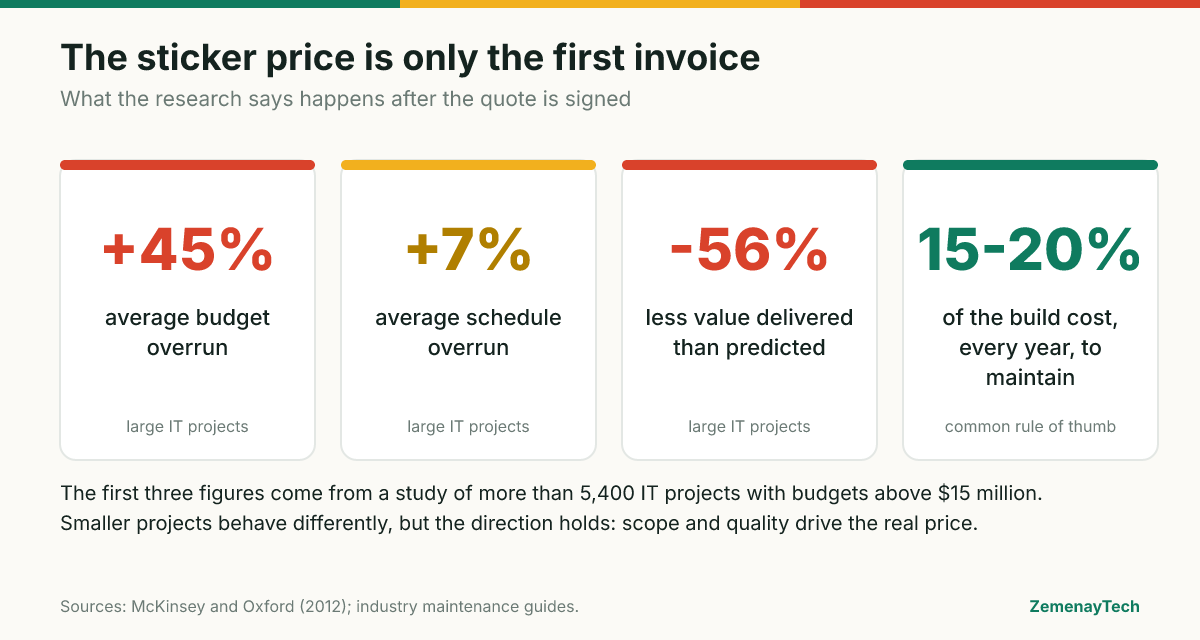
What the research says happens after the quote is signed. Sources: McKinsey and the University of Oxford; industry maintenance guides.
Rework and overruns
The most-cited study on the subject comes from McKinsey and the University of Oxford. After analysing more than 5,400 IT projects, the researchers found that large projects run 45% over budget and 7% over schedule on average, while delivering 56% less value than predicted. About 17% went so badly that they threatened the survival of the company that funded them. They also found that every extra year a project is scheduled to run adds roughly 15% to cost overruns.
A fair caveat: that study looked at projects with budgets above $15 million. Your $60,000 customer portal is a different animal. But the direction of the finding holds at every size. When scope is fuzzy and the team is wrong for the job, the invoice grows.
One European cost analysis goes further and claims that very cheap offshore engagements can see 30% to 50% rework costs that wipe out the initial savings. Treat that as one vendor's claim rather than a law of nature, but it describes the real risk well. A low rate attached to a weak team is not a bargain.
Running costs
Software is not a purchase, it is a pet. Industry guides consistently suggest budgeting 15% to 20% of the original build cost every year for fixes, security patches, compatibility updates and small improvements. On a $100,000 build, that is $15,000 to $20,000 a year, indefinitely. One 2026 analysis estimates that the five-year total cost of custom software is typically two to three times the initial build.
So what is the best price?
It is the lowest total across all four parts of the equation. That gives you three levers to pull:
- The rate: what each hour costs.
- The hours: how clearly the scope is defined and how efficiently the team works.
- The rework: how often the team gets it right the first time.
Geography mostly moves the first lever. Team quality and process move the other two. The smartest buyers pick a region that gives them a lower rate, then spend the savings on better scoping and better people.
What the world charges per hour
Rates differ widely between sources, vendors and seniority levels, so any table is a range and not a price list. With that in mind, here is one 2026 benchmark from QArea:
| Region | Typical hourly rate (2026) | Notes |
|---|---|---|
| North America and Western Europe | $80-$180+ | Strong local overlap, specialised and regulated work |
| Eastern Europe | $35-$80 | Complex custom software, partial US overlap |
| Latin America | $40-$90 | Strong US time zone overlap |
| South and Southeast Asia | $25-$60 | Large-scale offshore development, limited Western overlap |
| Africa | $25-$65 | Strong European overlap, focused teams and emerging hubs |
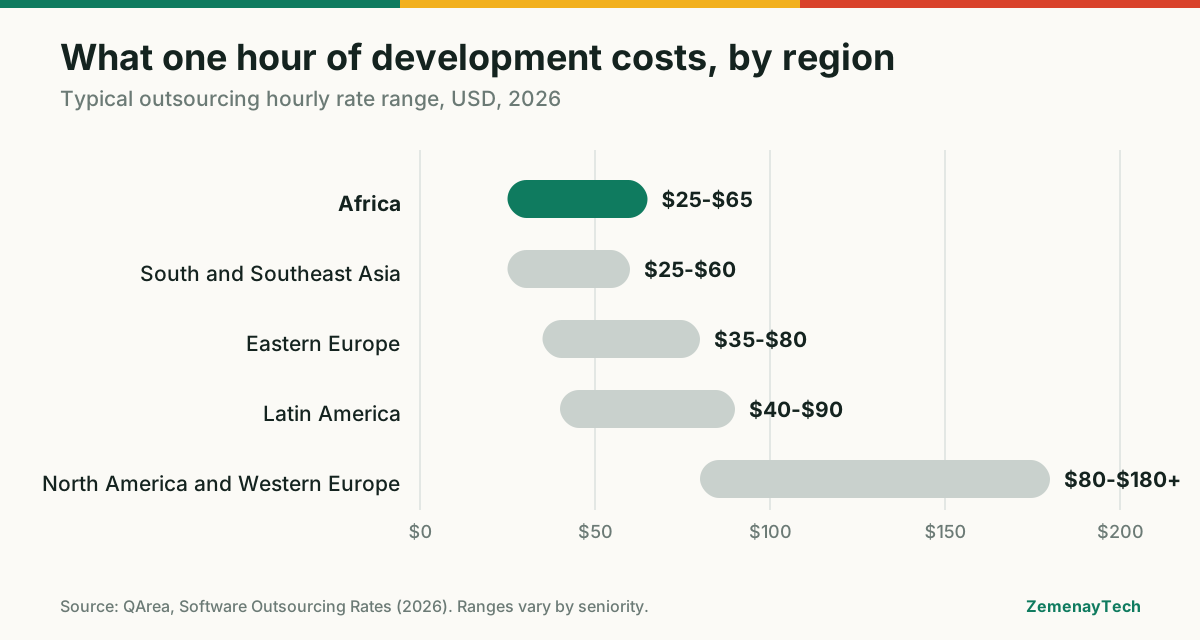
Typical outsourcing hourly rates by region. Source: QArea, 2026.
Other benchmarks tell the same story with different numbers. A May 2026 comparison from FullStack and RaftLabs puts the United States at $150-$300, Eastern Europe at $50-$120 and India at $25-$75. Another 2026 guide puts Africa at $20-$45, while Clutch-based data compiled by Qubit Labs lists African vendors anywhere from under $25 to $99. The exact figure moves around. The ordering does not.
What the gap means on a real project
Take a modest product team: 4 developers working for 6 months at 160 hours a month, which is 3,840 hours. Price those same hours at the midpoint of each regional range above and you get this:
| Region | Midpoint rate | Cost of 3,840 hours |
|---|---|---|
| North America and Western Europe | $130 | $499,200 |
| Latin America | $65 | $249,600 |
| Eastern Europe | $57.50 | $220,800 |
| Africa | $45 | $172,800 |
| South and Southeast Asia | $42.50 | $163,200 |
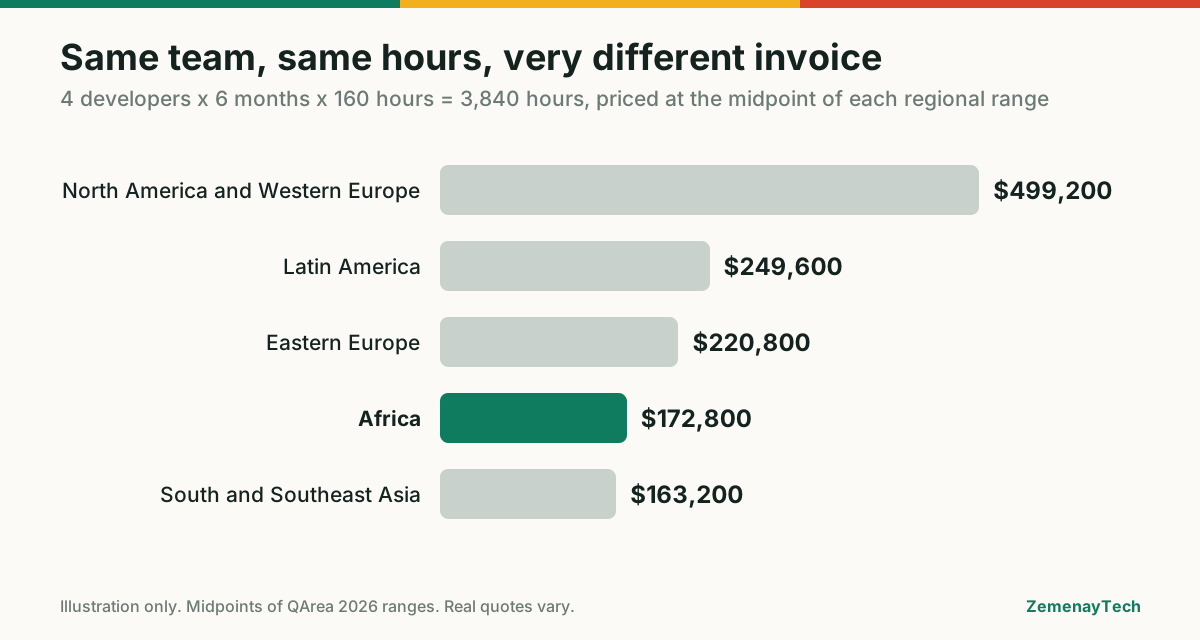
An illustration, not a quote. Midpoints of QArea's 2026 ranges.
At the midpoint, the African price is roughly a third of the North American and Western European one, a saving of about $326,000 on the same number of hours. Against Eastern Europe the saving is closer to 22%.
Two honest notes. First, hours are not identical everywhere: a very senior engineer in an expensive market may finish a task in fewer hours, which narrows the gap a little. Second, the cheapest region on paper is not automatically the best fit. This is exactly why the next question matters: if rate is only one lever, why look at Africa at all?
Why Africa belongs on your shortlist
The talent pool is growing faster than anywhere else
According to a March 2026 analysis by BCG, Africa had about 4.7 million developers in 2024. That is the smallest base of any region except Oceania, but it grew at 21% a year between 2019 and 2024, the fastest of any continent. North America grew at 9.2% over the same period.
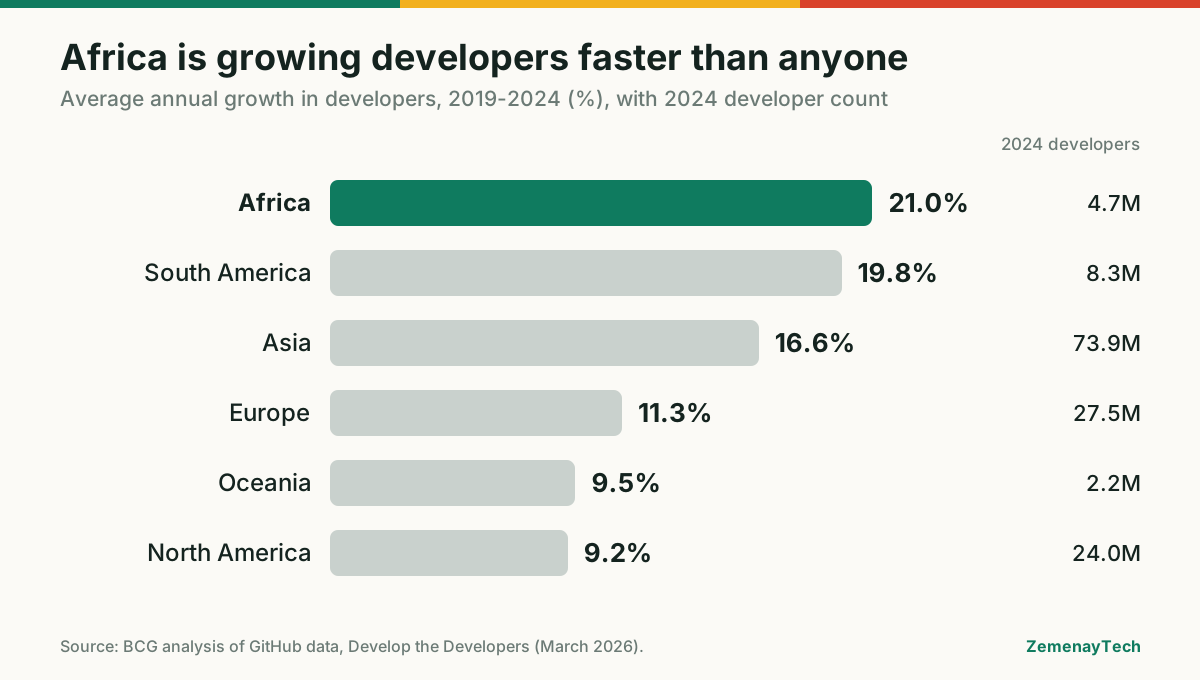
Average annual growth in developers, 2019-2024. Source: BCG analysis of GitHub data.
Other trackers show the same direction. GitHub's 2025 Octoverse report found that the Africa and Middle East region added 3.4 million new developers in a single year, and OpenUK counted around 9.3 million developer accounts across Africa in the first quarter of 2026. The numbers differ because the definitions differ: BCG and GitHub count students, hobbyists and self-taught coders alongside professionals. But nobody measuring this is finding a shrinking pool.
At the country level, Nigeria's developer community grew 45% in 2023, the largest jump of any country worldwide that year according to GitHub data. BCG also points out that Ethiopia and Angola grew their developer communities at the fastest rates in the 2019-2024 window, from very small bases.
The rate advantage is real
As the table above shows, African rates sit in the lowest tier globally, alongside South and Southeast Asia. For a buyer, that is the room in the budget to spend on better scoping, better testing and a longer runway.
The time zone works, especially for Europe
East Africa runs on UTC+3 all year round. That puts Ethiopia roughly one to three hours ahead of most of Europe depending on the season, which means most of the working day is shared with London, Amsterdam or Berlin. For the US East Coast, Ethiopia is seven to eight hours ahead, which still gives you a few live hours in your morning and a team that has already worked half a day by the time you open your laptop.
Where Africa is not the whole answer
QArea notes that Africa's senior talent pool is smaller than Eastern Europe's or Asia's, so access to specialised developers depends heavily on the partner you choose. The same guide advises extra scrutiny whenever a quote sits far below the regional average. We agree with both points. A deep pool of junior and mid-level talent is only valuable if someone is vetting, mentoring and managing it. That is the job of a good partner, and it is the reason this guide ends with a checklist for evaluating any vendor, including us.
Why Ethiopia stands out within Africa
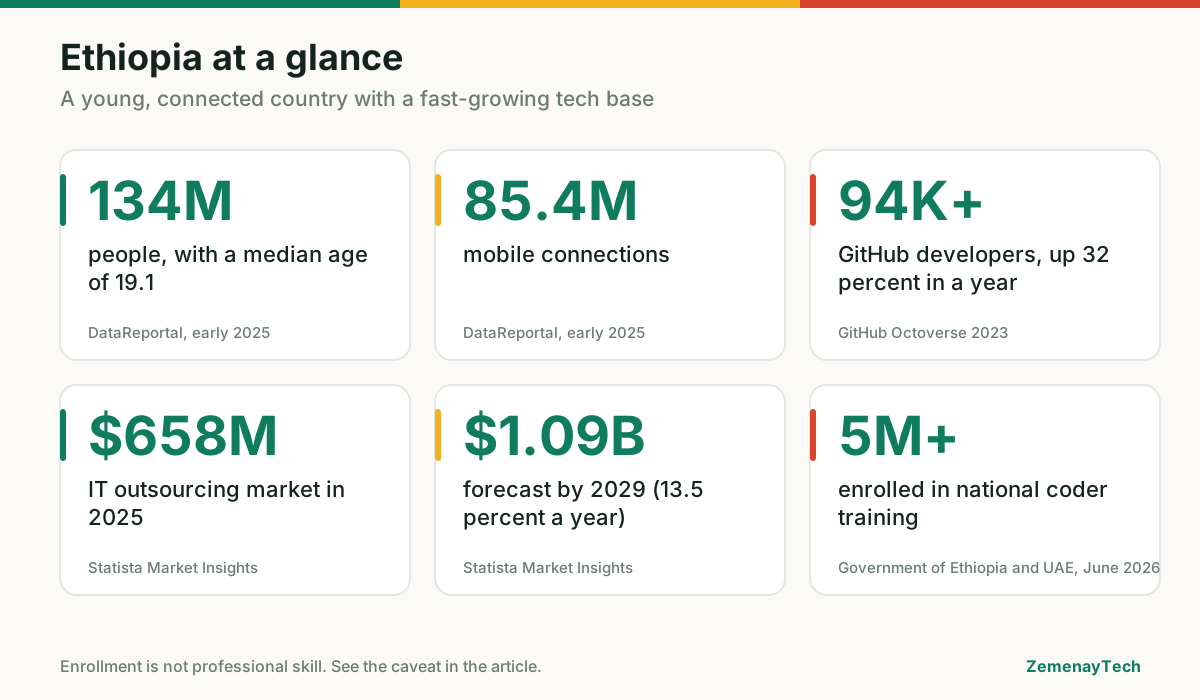
Ethiopia at a glance. Sources: DataReportal (via VillPress), GitHub Octoverse 2023, Statista, Government of Ethiopia and UAE.
A young country that is learning to code
Ethiopia had roughly 134 million people in early 2025 with a median age of just 19.1, and about 85.4 million mobile connections, according to DataReportal figures compiled by VillPress. Demographics like these mean a talent pipeline that keeps refilling.
The government is leaning into it. The "5 Million Ethiopian Coders" initiative launched in July 2024 in partnership with the UAE. In June 2026 the prime minister celebrated reaching the five million milestone, and the target has since been expanded to seven million.
Here is the caveat we promised. Those numbers count enrolments in foundational digital skills training, not working software engineers. Early in the programme, for instance, about 31,000 people had been certified out of roughly 246,000 enrolled. Local reporting has also noted that certificates and real skills are not the same thing, with civil servants rushing to collect certificates. The initiative is a genuine long-term investment in the base of the pyramid. It does not mean 5 million people are ready to build your payment platform.
The professional talent pool is smaller than the headlines
GitHub's Octoverse 2023 reported more than 94,000 developers in Ethiopia, growing 32% in a year. That is fast growth, but GitHub accounts include students and hobbyists. An older Google-based estimate from 2021 counted around 19,000 professional developers in the country. The truth sits somewhere between those two figures and moves up every year.
The practical takeaway: there is a lot of promising talent, and finding the strong people takes local knowledge. That gap is where an on-the-ground partner earns its fee.
The market is scaling
Statista projects Ethiopia's IT outsourcing market at about $658 million in 2025, growing around 13.5% a year to roughly $1.09 billion by 2029. Growth like that points to rising demand for software work inside the country as well, which gives local engineers more chances to learn on real projects.
What a developer costs here
Payscale puts the average base salary of an Ethiopian software engineer at about 40,000 birr a month, with the middle half of the market between roughly 22,000 and 53,000 birr. With the birr trading at about 161 per US dollar in early November 2026, that is about $250 a month on average, or roughly $137 to $329 across the middle of the market.
Please do not read that as a price list. Salary is not a vendor rate. A real vendor price also covers recruitment, management, QA, equipment, backup power and internet, and a margin. Published salary figures also vary widely between sources, and engineers at multinationals earn well above the average. What the data does tell you is that the underlying cost base is low, which is where the room in the hourly rate comes from.
Currency and inflation: what buyers should know
Ethiopia floated the birr in July 2024. Annual inflation was 14.9% in September 2026 and the central bank held its policy rate at 16% on 3 November. For a buyer paying in US dollars, this has two implications. The good news is that a dollar contract is shielded from birr swings. The less obvious news is that local wages rise with local inflation, so a responsible vendor will want to review rates once a year. Ask about this up front and write it into the contract. A vendor who says rates will never change is either planning to absorb the cost, or planning to cut corners.
Language, culture and working hours
English is widely used as the language of instruction in Ethiopian higher education, so many graduates read documentation, write tickets and join stand-ups in English without friction. Combine that with the time zone overlap covered earlier and Ethiopia works well as an extension of a European, Middle Eastern or even North American team.
Where ZemenayTech fits
ZemenayTech Outsourcing PLC is based in Bole, Addis Ababa. It was co-founded by Tehetna Askal and me, and we both started as remote developers. We did the work well enough that clients kept referring other clients, and eventually it made more sense to build a company than to keep taking projects one at a time.
Behind that is a simple conviction. Young Africans should not need to leave home to do world-class work. Quality local employment is one of the better answers to the economic pressure that pushes so many talented people to migrate. Every project we take on is also a well-paid job for a young Ethiopian engineer, and we build the company around that.
We run two service lanes:
- Technical talent: developers and engineers who join your team or build your product.
- BPO services: call centre and virtual assistant support for businesses that need reliable people on the phone and the inbox.
For software, our developer rates start from $8 an hour. The final number depends on seniority, team size and how long you need us. We have delivered for international clients including IDEEZA, and we are happy to talk you through that work on a call.
Here is how that connects back to the price equation from the start of this guide:
| Where the money leaks | What to ask any vendor | How we approach it |
|---|---|---|
| The rate | Ask for a rate card by seniority level, not one blended number | We quote by seniority and explain what each level does |
| The hours | Ask how scope is defined before work starts | We start with a conversation about outcomes, then break the work into stages |
| The rework | Ask who owns delivery and who reviews the code | Delivery is led by co-founder Tehetna Askal, so there is one accountable person on our side |
| The wrong people | Ask to meet the developers, not only the sales team | Technical talent placement is one of our two core lanes, so recruiting and vetting is what we do every day |
| The running cost | Ask for a maintenance quote before you sign the build | We are happy to quote the build and the run together |
Who ZemenayTech is a good fit for
- Startups and small businesses that want a dedicated development team without Western salary costs.
- Agencies and consultancies that want a reliable engineering partner behind their own brand.
- Companies in Europe and the Middle East that want overlapping working hours, and North American teams comfortable with a few live hours of overlap.
- Teams that value having a real person accountable for delivery.
Who it may not fit
- Projects that need a very large team on day one. We can phase it with you.
- Work that legally requires engineers to be on site in your country.
How to get a quote you can trust
Whoever you choose, these eight steps will protect your budget:
- Write a one-page brief. Describe the users, the outcome you want, and your constraints. A fuzzy brief is the number one cause of wildly different quotes.
- Ask for the price in three parts. Discovery, build and run. If a vendor will not quote the run, assume it will cost you later.
- Ask exactly who will work on it. Names, seniority and relevant experience. Be wary of "a team of experts" with no faces.
- Start with a small paid pilot. Two to four weeks on a real slice of the product tells you more than any proposal.
- Own your code from day one. Insist on repository access, documentation and intellectual property assigned to you.
- Agree on currency and review dates. Pay in a stable currency and agree when rates will be reviewed, especially in markets with higher inflation.
- Collect at least three quotes from at least two regions. Comparing across geographies shows you what the market really charges.
- Budget for the long term. Set aside 15% to 20% of the build cost every year for maintenance, and treat anything lower as an assumption you are taking on.
Frequently asked questions
How much does custom software development cost in 2026?
It depends on scope. One 2026 guide puts simple apps at $15,000 to $50,000, medium projects at $50,000 to $200,000, and complex systems at $200,000 to over $1 million. Where your team is located can move these numbers up or down by a factor of two or three.
Is outsourcing software development to Africa safe?
It is as safe as the vendor you pick. Check references, meet the developers, run a small paid pilot first and make sure you own your code. The same due diligence applies in Poland, India or Brazil.
Why Ethiopia and not Kenya, Nigeria or Egypt?
Those are larger and more established hubs, and for some projects they may be the right choice. Ethiopia's case is a low cost base, an extremely young population, fast developer growth and strong national investment in digital skills. The trade-offs are a smaller senior talent pool and currency and inflation dynamics that you should plan for. Ask any Ethiopian vendor about backup power and internet, too.
Should I choose fixed price or hourly?
Fixed price works when the scope is tightly defined and unlikely to change. Hourly or dedicated-team models work better when you are still learning what the product should be. Many buyers start with a fixed-price discovery phase, then move to a dedicated team for the build.
What currency would I pay in?
US dollars are the norm for international contracts. Agree on payment terms and an annual rate review in writing.
The bottom line
The cheapest quote and the best price are different things. The best price comes from a fair rate, a clear scope and a team that gets it right the first time. Geography gives you the biggest advantage on the rate, and Africa, with Ethiopia among its fastest-rising markets, offers rates that are hard to match anywhere else, alongside a talent pool that is growing every year.
If you are building something and want a second quote from a team in Addis Ababa, tell us what you have in mind. We will give you a straight answer on scope, team and cost, and if we are not the right fit, we will say so.
Talk to ZemenayTech about your project
Sources
Data last checked on 10 November 2026. Figures are rounded and sources define "developer" differently, so treat comparisons as directional.
- BCG, Develop the Developers: A Strategic Priority for Africa (March 2026)
- OpenUK, Open Source Africa Report (March 2026), citing GitHub Octoverse 2025
- GitHub, Octoverse 2023: The state of open source and rise of AI
- Andela, Africa's Emergence as the World's Next IT Services and AI Talent Destination
- McKinsey and University of Oxford, Delivering large-scale IT projects on time, on budget, and on value
- QArea, How Much Does It Cost to Outsource Software Development? 2026 Rates
- FullStack and RaftLabs, Nearshore Engineering Economics 2026
- Capital Numbers, How Much Does Offshore Software Development Cost in 2026?
- Qubit Labs, Guide to Offshore Software Development Rates by Country in 2026, citing Clutch
- Easy.bi, What Does Custom Software Development Actually Cost in 2026?
- Code Stringers, Software Maintenance Costs Explained
- Vasundhara, Custom Software Development Cost in 2026 After AI
- VillPress, See How Ethiopia's Tech Scene Is Taking Shape Rapidly, citing DataReportal
- Statista Market Insights, IT Outsourcing in Ethiopia
- Ethiopian News Agency, PM Abiy hails 5 Million Ethiopian Coders milestone (June 2026)
- WAM, UAE and Ethiopia expand the 5 Million Ethiopian Coders Initiative to 7 million (July 2026)
- Tech Stars, Ethiopia trains 31,000 young coders in three months (October 2024)
- Addis Fortune, Civil servants rush to secure digital certificates, skills take a back seat (April 2026)
- Scrums.com, African Tech Talent: Global Demand and Opportunities, citing Google (2021)
- Payscale, Average Software Engineer Salary in Ethiopia
- The Rio Times, Cost of Living in Ethiopia for Expats and Ethiopia's Central Bank Holds Rate at 16% (November 2026)